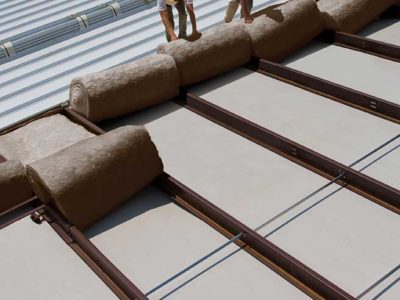
You’re finally ready to insulate your metal building; however, you’re having trouble deciding between a high-R-value liner system and a traditional blanket insulation system. Well, this decision may be one of the most significant determinations you’ll make; choosing the wrong metal building insulation can lead to higher costs, poor energy efficiency, and long-term headaches.
This guide breaks down the pros and cons of each system and the conditions that determine which one to use so that you can make a confident, cost-effective decision. You will learn how to choose the Right Insulation for Your Metal Building.
The Difference Between the Two?
Blanket Insulation System
When considering insulation options, blanket insulation systems provide a flexible and efficient solution.
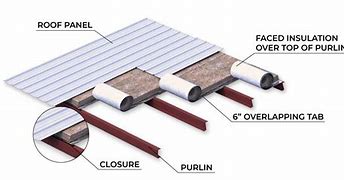
A blanket insulation system is often called fiberglass blanket insulation, vinyl-faced insulation (such as WMP-VR-R+, WMP-10, WMP-30, WMP-50), and roll insulation (R-8, R-10, R-13, R-19), and is installed between the purlins and girts.
Benefits of a Blanket Insulation System:
- Lower initial cost
- Quicker Installation Process
- Average thermal efficiency and performance
- Utilized in a wide range of building purposes
High R-Value Liner System
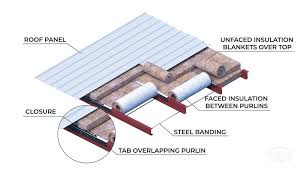
A High R-Value Liner System blanket system is often called energy-efficient insulation, climate-controlled insulation, and a vapor barrier liner uses a combination of unfaced insulation + a separate liner fabric, allowing for higher total R-values (usually R-40+) and better thermal continuity.
Primary Aspects or Benefits of High R-Value Liner Systems
- Thicker insulation (usually R 30 +)
- Reduced thermal bridging
- Thermal bridging occurs when heat or cold can bypass your insulation through an exposed “bridge” material, such as metal or wood (which is more conductive).
- Has an attractive, cleaner look
- Perfect for climate-controlled buildings
A Blanket Insulation System is Chosen When…
A blanket insulation system is often the selection for those looking for a DIY project. It is a much easier installation process and far more budget-friendly.
Ideal For:
- Non-heated or minimally heated buildings
- Though blanket insulation is utilized in heated structures (usually with WMP-30 or WMP-50), ideally, High R-Value Liner Systems are the better choice.
- Agricultural buildings (riding arenas, machinery sheds, barns)
- Low-occupancy warehouses
- When you need to save money
- Time is of the essences
Simply put, blanket systems provide you with adequate thermal efficiency while saving you money. If temperature control is not a priority, it is the smart choice. However, it has limitations, such as reduced R-value options and lower thermal efficiency compared to a linear system.
A High R-Value Liner System is Chosen When…
Ideally, one chooses a high R-value liner system when a building is primarily heated or cooled and is continually occupied. No one wants to be uncomfortable while living or working in a structure due to temperature-control limitations. If you have the extra initial investment, it is the wiser long-term investment.
Ideal For:
- Commercial or industrial facilities with constant people
- Structures that have HVAC systems or climate-sensitive storage, like food plants or ice-skating arenas.
When you don’t have a high R-value liner system, the insulation is compressed, though the extent is limited. A Liner system allows the insulation to expand to its natural thickness. This, in turn, improves the insulation’s thermal efficiency and performance. You will reap lower energy bills and more consistent temperatures. Again, if there are pros, there must be a few cons: a higher upfront cost and more skilled labor for installation.
Summation:
When choosing between Blanket Insulation and a High R-Value Liner System, one should consider the Initial cost, the R-Value Potential, Energy Efficiency, Condensation Control, and Appearance. There is definitely a trade-off. Although the Liner systems are superior in their application across these areas, they incur higher costs, require longer timelines, and offer reduced ease of installation compared to blanket insulation. Just remember, if you plan to heat or cool your building, a liner system often pays for itself over time through energy savings and improved performance.